Salesforce Commerce Cloud: 2025 US E-commerce Enhancements

Salesforce Commerce Cloud is poised for significant evolution in 2025, introducing crucial enhancements designed to empower US enterprise e-commerce businesses with advanced AI, deeper personalization, and more agile commerce solutions.
The landscape of e-commerce is constantly shifting, demanding platforms that are not only robust but also adaptable and forward-thinking. For US enterprise businesses, staying ahead means leveraging the most advanced tools available. This article delves into the Salesforce Commerce Cloud: 5 Key Enhancements for US Enterprise E-commerce in 2025, offering a glimpse into how these innovations will shape the future of digital retail.
The rise of AI-driven personalization
Artificial intelligence continues to transform the way consumers interact with brands online. In 2025, Salesforce Commerce Cloud will significantly deepen its integration of AI, moving beyond basic recommendations to offer truly individualized shopping experiences for US enterprise e-commerce businesses. This enhancement aims to predict customer needs with greater accuracy and deliver tailored content at every touchpoint.
This evolved AI capability will not merely suggest products based on past purchases. Instead, it will analyze real-time browsing behavior, demographic data, and even external trends to create a hyper-personalized journey for each shopper. The goal is to make every customer feel understood and valued, fostering loyalty and driving conversion rates.
Predictive analytics for proactive engagement
One of the core components of this AI advancement is enhanced predictive analytics. This allows businesses to anticipate customer intent and engage proactively, rather than reactively. Imagine a customer browsing winter coats; the system could immediately offer complementary accessories or suggest a personalized discount based on their past engagement and predicted likelihood to purchase.
- Real-time behavioral analysis for dynamic content delivery.
- Anticipatory product recommendations based on evolving trends.
- Personalized promotional offers tailored to individual preferences.
- Automated customer service interactions guided by purchase history.
The impact of AI-driven personalization extends beyond mere sales. It improves the overall customer experience by reducing friction, making shopping more efficient, and creating a more engaging environment. For enterprise e-commerce, this translates into higher customer satisfaction and a stronger brand presence in a competitive market.
Composable commerce architecture for agility
The need for flexibility and speed in e-commerce cannot be overstated. Traditional monolithic platforms often struggle to keep pace with rapid market changes and evolving business requirements. Salesforce Commerce Cloud’s push towards a more composable commerce architecture in 2025 directly addresses this challenge, offering US enterprises unparalleled agility.
Composable commerce allows businesses to select and assemble best-of-breed components from various vendors, rather than being locked into a single, all-encompassing platform. This modular approach provides the freedom to innovate faster, integrate new technologies seamlessly, and adapt to specific business needs without extensive custom development.
Microservices and API-first approach
At the heart of composable commerce is a microservices-based, API-first approach. This means that different functionalities, such as product information management, order management, and checkout processes, are broken down into independent, interchangeable services. Each service communicates via robust APIs, enabling greater flexibility and easier integration.
- Decoupled frontend and backend for independent development.
- Easier integration with third-party applications and services.
- Scalability of individual components without affecting the entire system.
- Reduced time-to-market for new features and functionalities.
This architectural shift empowers enterprises to build highly customized and future-proof e-commerce experiences. It moves away from the ‘one-size-fits-all’ mentality, allowing businesses to craft unique digital storefronts that truly reflect their brand identity and cater to their specific customer base. The enhanced agility offered by composable commerce will be a significant advantage for US enterprises looking to differentiate themselves.
Enhanced omnichannel customer journey orchestration
Customers today expect a unified and seamless experience across all touchpoints, whether they are browsing on a mobile device, visiting a physical store, or interacting with customer service. In 2025, Salesforce Commerce Cloud will significantly enhance its capabilities for orchestrating the omnichannel customer journey, making it easier for US enterprise e-commerce businesses to deliver consistent and personalized interactions.
This enhancement focuses on breaking down silos between various channels, ensuring that customer data and interactions are synchronized in real-time. The goal is to provide a holistic view of each customer, enabling businesses to pick up conversations exactly where they left off, regardless of the channel previously used.
Unified customer profiles and data synchronization
A crucial aspect of enhanced omnichannel orchestration is the creation of unified customer profiles. By consolidating data from all interactions—online purchases, in-store visits, service inquiries, and marketing engagements—businesses gain a complete understanding of their customers. This unified view fuels more intelligent personalization and more effective engagement strategies.
- Seamless transitions between online and offline shopping experiences.
- Consistent brand messaging across all customer touchpoints.
- Personalized recommendations based on cross-channel behavior.
- Improved customer service with a complete interaction history.
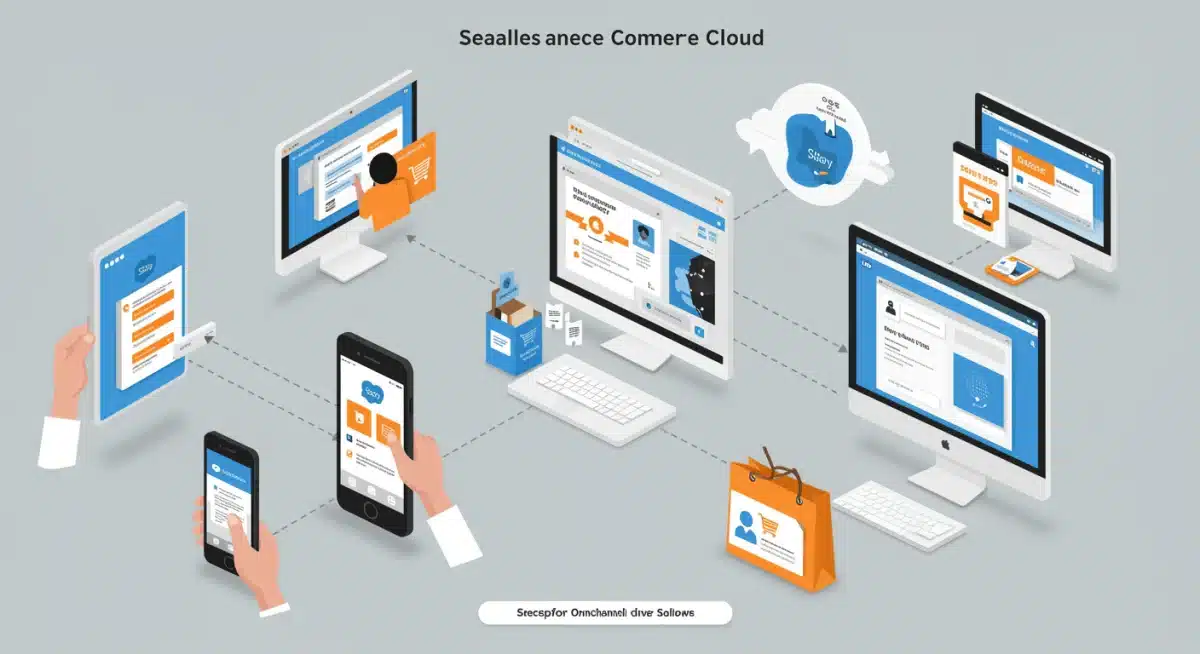
By streamlining the omnichannel experience, Salesforce Commerce Cloud empowers enterprises to build stronger relationships with their customers. It reduces frustration, increases satisfaction, and ultimately drives repeat business. A truly orchestrated customer journey ensures that every interaction adds value, reinforcing brand loyalty and contributing to long-term growth.
Advanced B2B e-commerce functionalities
While often associated with B2C, Salesforce Commerce Cloud is also a powerful platform for business-to-business (B2B) e-commerce. In 2025, the platform will introduce advanced functionalities specifically tailored to the complex needs of B2B enterprises in the US market. These enhancements aim to streamline procurement processes, improve buyer experiences, and drive efficiency for B2B transactions.
B2B e-commerce often involves intricate pricing structures, contract-based purchasing, complex approval workflows, and integration with existing ERP systems. The upcoming enhancements will address these unique requirements, making Salesforce Commerce Cloud an even more compelling choice for B2B businesses seeking to modernize their online sales channels.
Streamlined procurement and self-service portals
Key among the B2B enhancements will be improved capabilities for streamlined procurement and robust self-service portals. These features will empower B2B buyers to manage their accounts, place orders, track shipments, and access personalized pricing and catalogs with greater ease and independence, reducing the burden on sales teams.
- Configurable pricing models for different customer segments.
- Support for complex order types, including bulk and recurring orders.
- Integration with existing enterprise resource planning (ERP) systems.
- Enhanced account management and self-service capabilities for buyers.
These specialized B2B features will enable US enterprises to offer a more consumer-like experience to their business customers, meeting the rising expectations for convenience and efficiency. By simplifying the purchasing process and providing powerful self-service tools, Salesforce Commerce Cloud will help B2B companies improve operational efficiency and foster stronger client relationships.
Sustainable commerce initiatives and reporting
As consumer awareness and demand for ethical and sustainable practices grow, businesses are increasingly expected to demonstrate their commitment to environmental and social responsibility. In 2025, Salesforce Commerce Cloud will integrate enhanced features to support sustainable commerce initiatives and provide comprehensive reporting for US enterprise e-commerce.
These enhancements will allow businesses to more effectively track, measure, and communicate their sustainability efforts throughout the supply chain and customer journey. From product sourcing to delivery, the platform will offer tools to promote eco-friendly practices and transparently share their impact with consumers.
Transparency and ethical sourcing tools
New tools will focus on improving transparency regarding product origins, manufacturing processes, and environmental impact. This includes features that enable businesses to highlight ethically sourced materials, display carbon footprint data for products, and showcase certifications or partnerships with sustainable organizations directly on their e-commerce sites.
- Integration with supply chain sustainability tracking platforms.
- Features for displaying product-specific environmental impact data.
- Tools to promote eco-friendly shipping options and packaging.
- Reporting dashboards to monitor and communicate sustainability metrics.
By offering robust tools for sustainable commerce, Salesforce Commerce Cloud empowers US enterprises to meet consumer demand for responsible business practices. This not only builds brand trust and loyalty but also contributes to a more sustainable future for the e-commerce industry. The ability to effectively communicate these efforts will be a key differentiator in 2025.
Enhanced security and compliance for data protection
In an era of increasing cyber threats and stringent data privacy regulations, robust security and compliance are paramount for any e-commerce platform. For US enterprise e-commerce, Salesforce Commerce Cloud will further enhance its security measures and compliance frameworks in 2025, providing businesses with peace of mind and protecting sensitive customer data.
These enhancements will focus on strengthening data encryption, improving threat detection, and simplifying compliance with evolving regulations such as CCPA, GDPR, and other industry-specific standards. The goal is to create an even more secure environment for transactions and personal information, reinforcing customer trust.
Advanced threat detection and data encryption
The platform will integrate more sophisticated threat detection mechanisms, utilizing AI and machine learning to identify and mitigate potential security breaches before they can impact operations. Alongside this, advancements in data encryption will ensure that customer data, from payment details to personal preferences, remains secure both in transit and at rest.
- Continuous monitoring for suspicious activities and anomalies.
- Enhanced multi-factor authentication (MFA) options for administrators.
- Simplified tools for managing data privacy consent and preferences.
- Regular security audits and compliance updates to meet evolving standards.
These security and compliance enhancements are vital for maintaining customer confidence and avoiding costly data breaches or regulatory penalties. For US enterprise e-commerce, a secure and compliant platform like Salesforce Commerce Cloud is not just a feature, but a fundamental requirement for successful and trustworthy operations in 2025 and beyond. It underpins the entire digital commerce ecosystem, ensuring that businesses can operate with integrity and protect their most valuable assets: customer trust and data.
| Key Enhancement | Brief Description |
|---|---|
| AI-driven Personalization | Delivers hyper-individualized shopping experiences, predicting needs and tailoring content in real-time. |
| Composable Commerce | Offers modular architecture for agility, allowing businesses to integrate best-of-breed components. |
| Omnichannel Orchestration | Synchronizes customer data across channels for seamless and consistent interactions. |
| B2B Functionalities | Streamlines procurement and provides robust self-service portals for complex B2B needs. |
Frequently asked questions about Salesforce Commerce Cloud in 2025
AI-driven personalization is expected to significantly boost conversion rates by delivering highly relevant product recommendations and content. By understanding individual customer preferences and behaviors in real-time, the platform can tailor the shopping experience, making it more engaging and increasing the likelihood of purchase.
Composable commerce offers increased agility, allowing enterprises to quickly adapt to market changes and integrate new technologies. It provides the flexibility to choose best-of-breed components, reducing vendor lock-in and enabling faster innovation cycles for unique business requirements.
Enhanced omnichannel orchestration creates a seamless and consistent customer journey across all touchpoints. By synchronizing customer data, it ensures that interactions are personalized and continuous, leading to higher customer satisfaction, stronger brand loyalty, and reduced friction in the shopping process.
US enterprises can expect advanced B2B functionalities like streamlined procurement, configurable pricing models, and robust self-service portals. These features are designed to simplify complex B2B transactions, improve buyer independence, and integrate seamlessly with existing ERP systems, enhancing efficiency and satisfaction.
Salesforce Commerce Cloud will integrate features for tracking, measuring, and communicating sustainability efforts. This includes tools for transparency in product sourcing, displaying environmental impact data, promoting eco-friendly options, and providing reporting dashboards to meet growing consumer demand for ethical practices.
Conclusion
The year 2025 is set to be a transformative period for US enterprise e-commerce, with Salesforce Commerce Cloud leading the charge through its significant platform enhancements. From the precision of AI-driven personalization to the flexibility of composable commerce, and from seamless omnichannel orchestration to specialized B2B functionalities, these advancements are designed to empower businesses to meet and exceed evolving customer expectations. Furthermore, the platform’s commitment to sustainable commerce and robust security measures underscores a holistic approach to modern digital retail. By embracing these key enhancements, enterprises can build more resilient, agile, and customer-centric e-commerce strategies, ensuring sustained growth and competitive advantage in a dynamic market.